
Before launching his brand, PlazaWorks in 2023, designer Chee Maduekwe did his homework. He first had the idea of a denim brand while working in product development at Canada Goose, about four years ago. He’d been wearing his A.P.C. New Standards to death and loved how the raw selvedge denim whiskered over time, but he thought the fit could use an update—to start, maybe a longer rise and a wider leg. Maduekwe then went to the denim experts at Dutil for a literal fit check. “I told them I wanted to see six or seven brands in every size.” Eighteen months of R&D later, Maduekwe launched PlazaWorks with an overnight hit: the Modern 5 Pocket Jean in an indigo selvedge. Now, the designer is taking his fledgling brand from Parkdale to Paris, and beyond.
You’re going to Paris soon, right? I feel like more and more Toronto designers and retailers now go to fashion week.
⎯⎯⎯ I feel like with all the other brands doing well, it creates an ecosystem where [industry] people see that we can do this. I think over the past five years, since COVID, I've noticed there's a bunch of Toronto brands that have let everybody know that they can do things at a very high level, and I think the more brands like that that exist, the better it is for all of us.
Fashion is so global, but also so corporate. So, it’s cool to see a new group of independent designers, stores, podcasters, and Substackers, who mostly met online, help each other out, and put people onto Toronto designers. It’s the only time the internet works how it’s supposed to.
⎯⎯⎯ Exactly, that's actually a huge thing. I hope it continues because when you go to these “fashion cities” that I've been to, like Paris, you get a sense of not only the community and the culture, but of the government. The arts and fashion: they want to cultivate it.
They invest in it.
⎯⎯⎯ So many companies and brands are like, "Hey, are you a young designer? We'll fund you. Just give us a cut.” Here, in Toronto, if you're in music and film and you want to do something, the government will throw money at you. It’s gonna take a lot of us designers at this stage to keep doing what we're doing, and keep growing at a level where people beyond the shoppers take notice.
Why raw denim? What were the design considerations for the fit?
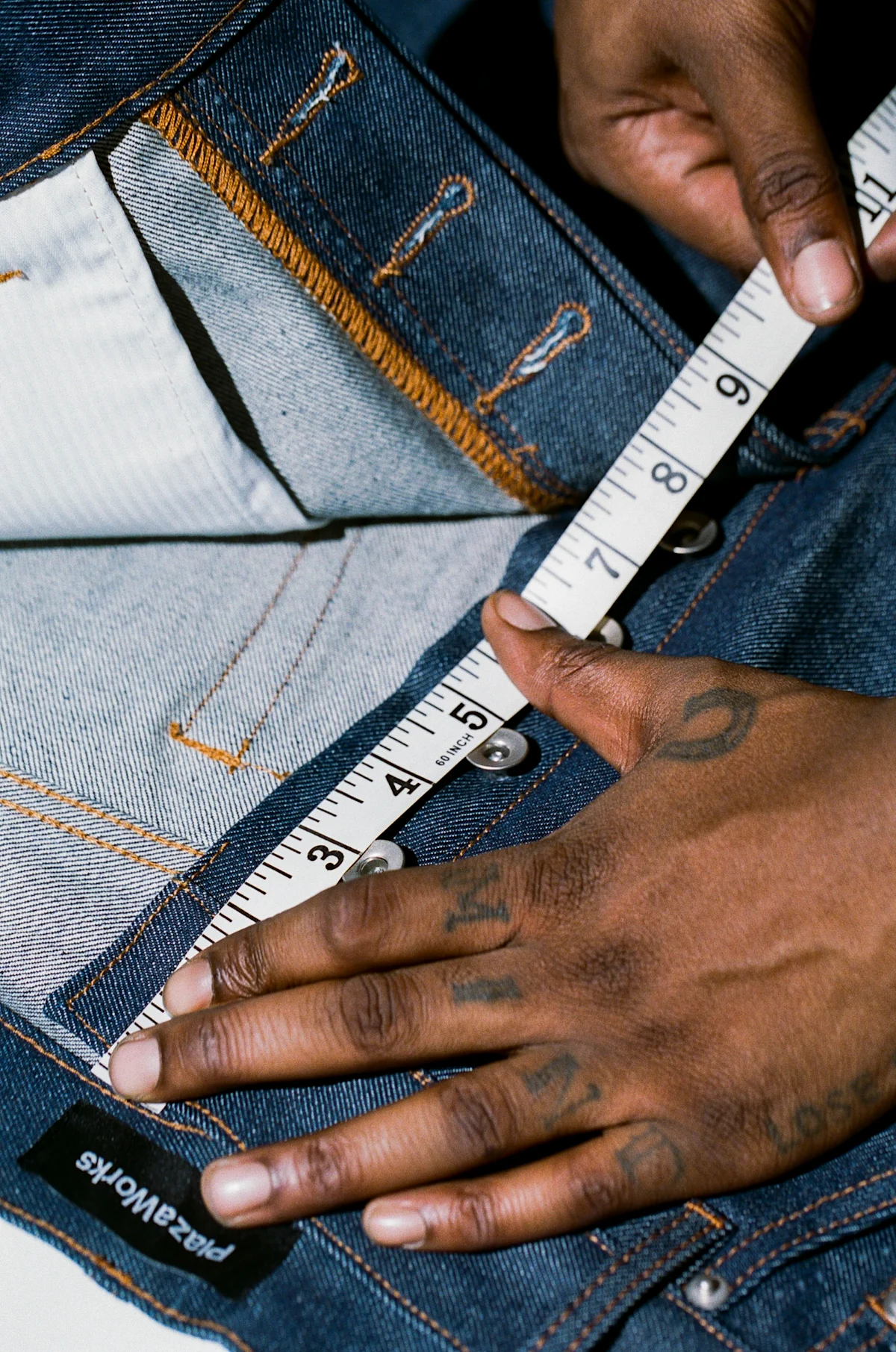
⎯⎯⎯ The main considerations were that I wanted it to be raw selvedge denim—selvedge, in particular, because it adds a sense of craftsmanship. It’s made on old-school shuttle looms, and that process is becoming rare. You don’t really see it on an everyday level anymore, so we wanted to give the product a sense of prestige. Raw denim was also important because the type of clothes we want to make is meant to be long-lasting and durable. That’s the ethos of the brand: pieces that look good and hold up. At the time, I was wearing my first pair constantly and completely wearing them into the ground. Seeing how durable they were and how the denim faded was a really cool experience. That’s what I wanted to give customers—something personal, but done my way. We sourced the denim from Japan through a company in Los Angeles that works as a middleman for smaller brands. It was really fun back then. I was excited to make every pair, even when I had a lot going on at once and was still improving my sewing skills. The hardest part, by far, was the fit. Making the clothes is fun, but in some ways it’s the easiest part. Overall, it was a long process and a lot of work—probably more than I’m even giving it credit for. But I enjoyed it at the time. I don’t think I could do it that way again now. With the knowledge I have today, it wouldn’t take nearly as long, even for a new product, but still, when I look back, I honestly don’t know how I did it, even though ot was only about two years ago.
That’s why you have to go in blind. If you know how hard it’s gonna be, you wouldn’t do it.
⎯⎯⎯ I'm glad I didn't know. Sometimes you need the arrogance of thinking you’re just gonna figure it out. That's why I say it's the scariest thing that I've ever done in my life. I've gotten the most devastating news and then the best news in the span of like, 20 minutes. One thing I try to do is just try to keep as even-keeled as possible, because you actually go mad if you just ride the ups and downs of it.
Seems like you figured it out pretty quickly.
⎯⎯⎯ One thing I would say is that I'd done this before, and it didn't work. And then I did a lot of research on what should work. Also, I've lived downtown for like 11 years. I’m very involved in what's going on. A lot of friends who are willing to help out, willing to do things for me, help accelerate certain things.
How so?
⎯⎯⎯ For example, I have a friend who works at Hullmark, and they gave us a showroom for an insane price. People are coming to this fancy, big showroom that looks so nice, and it really helped elevate the perception of our brand. A lot of friends who are influential have been helpful in different ways. For the photoshoots, I asked friends who live downtown who I’ve known for a while, like Majid Jordan, who recently did a whole shoot for us. I’m just really thankful that we’re able to do things like that. It really helps. It gives us a little more credibility and enhances what we’re trying to do. It speaks to the fact that we’ve been involved in downtown for a very long time, and then we came up with something that was already kind of put together. I think people were interested in being a part of it and helping out. They’re like, “Okay, we’ll help you out.” I think those relationships have been really, really important to the growth of the company.
Kind of crazy no one's asked me to model.
⎯⎯⎯ I didn't know you were willing! I'm actually serious. We're always looking.
I'm a call away.
⎯⎯⎯ A lot of my friends work in production. I listen to them talk about the ins and outs of art direction, lighting, and set design. I have no clue. But whenever I get to talk about marketing or selling clothes, I love it. I love the ideology behind why somebody buys clothes, why somebody buys anything. I could talk about that stuff forever.
It’s all I think about and want to talk about.
⎯⎯⎯ I love consumer marketing and trying to understand it. Honestly, I did a talk at George Brown for fashion students last year, and I told them that one of the reasons a lot of fashion brands don’t work is because of how fashion is taught. It focuses too much on the psychology of what you think you are, instead of what you’re actually doing. I would tell them all the time: it’s not so much about making clothes, it’s about selling clothes. Especially when I worked at Canada Goose, you realize anybody can make clothes. But as I got more and more into what I was doing, I realized that selling the clothes—and how you go about doing that—is the most important part. Production feels easier to me because there’s a clear answer every time. It’s like math—there’s always an answer. Marketing, on the other hand, is new all the time. It’s changing constantly. You’re always trying to figure out what’s going on and adjusting what you’re doing to make it work. It never stops. I don’t know, I just think that if you want to have a good brand, you have to put more attention into that side of things.
That’s one thing this town needs more of: creative directors.
⎯⎯⎯ But, like, actual creative directors. I think there are very few people who have the capabilities of being a creative director. Coming up with grand-scheme ideas is one thing, but you have to understand the full machine of how every single element operates in order to be at the top and really decipher it and make decisions on, like, “Hey, here’s how this works.” There are a lot of people who are good art directors, but I don’t think there are a lot of good creative directors.
What do people get wrong about fashion?
⎯⎯⎯ When I was in fashion school, the dropout rate was ridiculous. People thought it was something else, and they would drop out like flies. You’d just come to class, and they’d be like, “Where’s such and such?” and they were gone. A lot of people have this perception of what working in the fashion industry is, and it’s just not that. I sometimes tell people it’s the trades. I don’t think a lot of people understand there’s a lot of grittiness. It’s not really as glamorous as it seems. There’s a lot of hard work put in, a lot of different skills, actual tangible stuff, book stuff, theoretical stuff, and then overall creative stuff. You have to have so many skills and be willing to do so many things. I fall into that category of person who came at fashion from another angle, because it wasn’t until my mid-20s that I started researching fashion and really looking into it. I just liked clothes for a long time, and as the interest built, I did my research. I had an interest in so many different things, and I was like, how do I put this together? Fashion was one of the best meetings for me to do all those things.
Okay, rapid-fire questions. Do you want to be rich or cool?
⎯⎯⎯ Rich. Cool doesn’t pay the bills.
Toronto forever or Toronto for now?
⎯⎯⎯ Toronto for now.
Favourite restaurant?
⎯⎯⎯ This Jamaican spot, Sheryl’s.
Favourite bar?
⎯⎯⎯ Bowie. I just feel comfortable there.
What’s the most expensive piece of clothing you ever bought?
⎯⎯⎯ This Yohji Yamamoto flannel, a long time ago. It was like $1,700.
Oh, I forgot to ask: Where does the brand name come from?
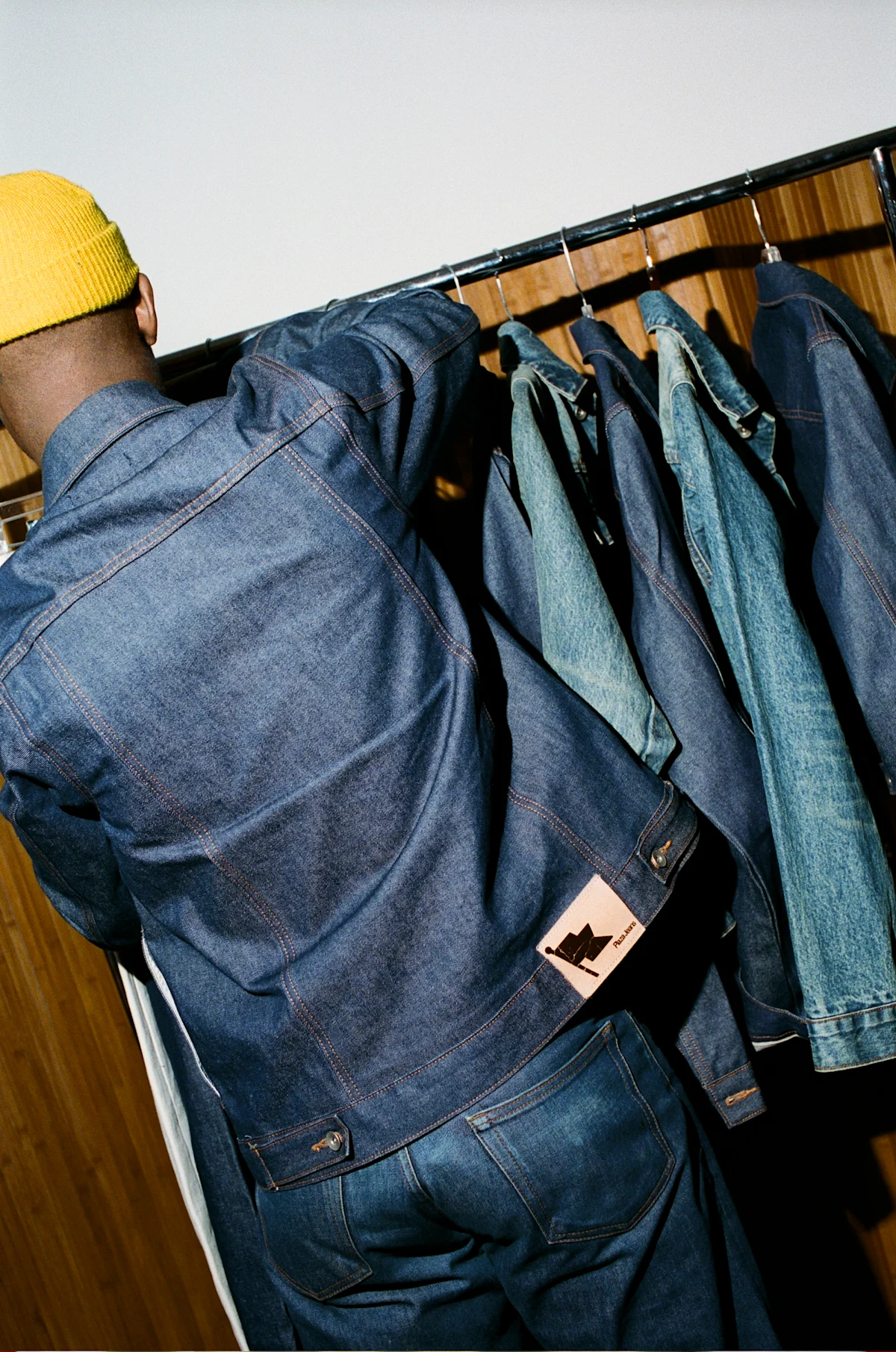
⎯⎯⎯ I grew up in Pickering, outside of Toronto. If you grew up in the suburbs, you would know that plazas are the centre of everything. There’s a grocery store, a pet store, a convenience store, a Chinese food restaurant. I was thinking about what I wanted this brand to represent, and a plaza is kind of essentially what it is: all these different people, all these different cultures, all these different insights, all in this thing together.
And what does the future look like for PlazaWorks?
⎯⎯⎯ I think what we want to do is expand our retail footprint and get into a lot more stores. I want to expand our product range outside of denim, because denim is just what we started with. I love denim, but there are so many other types of clothes that I want to make. I also want to make lower barrier-to-entry products. Our jeans are $310, which I think is a pretty good value, but not everybody is willing or has $310 to drop. We’d love to include more products that still uphold the same quality but are at a cheaper price point, so people can get involved with the brand. A big aspect of our brand is community. I know that sounds cliché, but I say it because we actually do it. I think we are really a community-based brand, and I want to keep highlighting that through collaborations, events, and shows with other Toronto or Canadian companies. Over the next year or five years, those are the major goals: make more products, have more people see what we’re doing, and get into more stores.
– East Room is a shared workspace company providing design-forward office solutions, authentic programming and a diverse community to established companies and enterprising freelancers. We explore art, design, music, and entrepreneurship. Visit our News & Stories page to read more.

