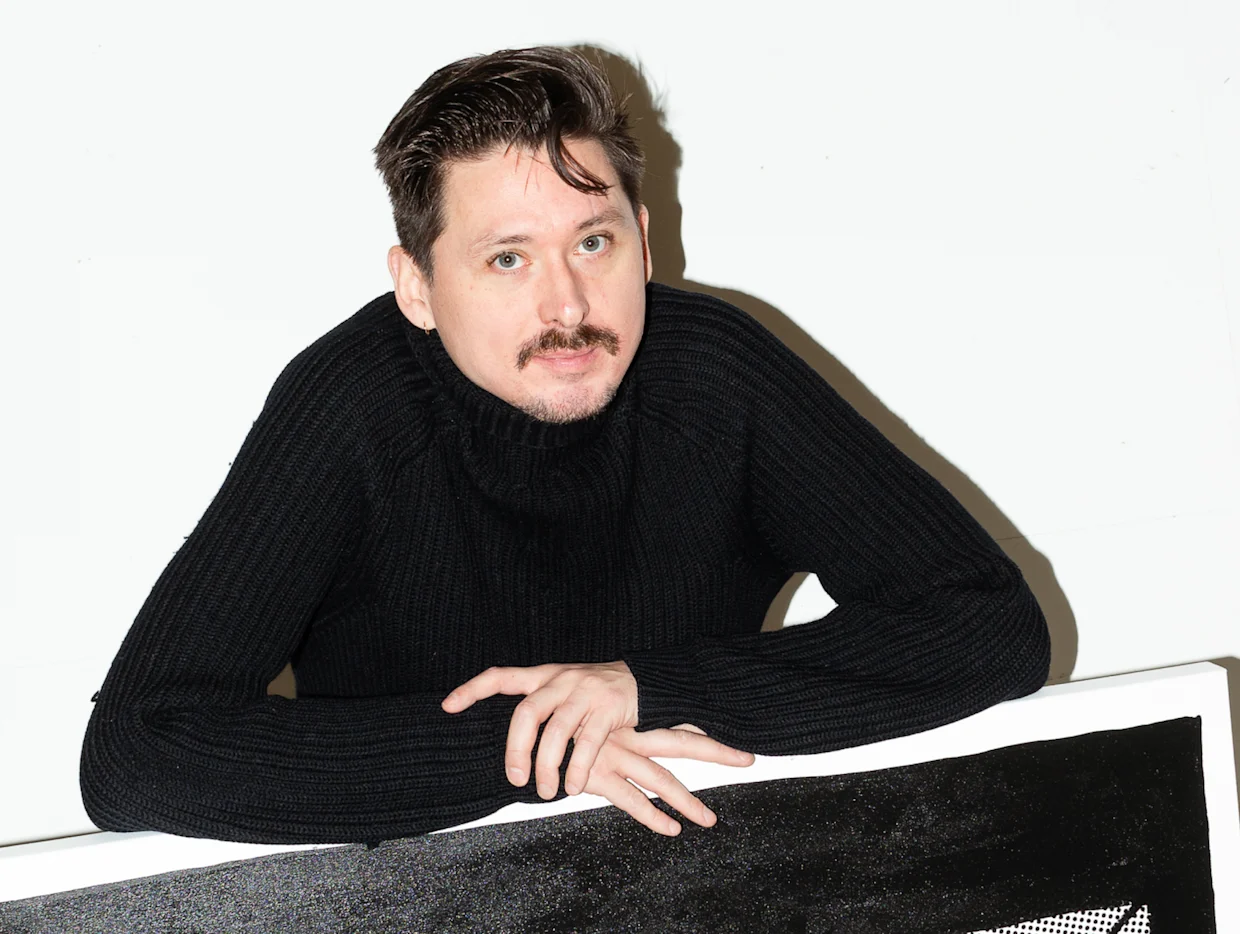
Walter Scott is an artist whose practice explores the intersection of image and language, often navigating between abstraction, comics, and text-based work. His paintings and installations investigate communication, perception, and the ways meaning can shift depending on context, blending direct visual language with playful, poetic experiments. Known for his willingness to push formal and conceptual boundaries, Scott continually challenges both himself and his audience to engage with art in unexpected ways.
I want to start by talking about your show at Hunt Gallery. From what I read, it was a bit of a different approach for you because it was more collaborative. Daniel from Hunt Gallery had a lot of say, or at least a lot of feedback, on the work you were producing because you were sharing so much with him. How was that process for you, and did it open something up in your creative practice that you hadn’t explored before?
⎯⎯⎯ Well, I think it's very rare that a gallerist will come into a studio and really say what they think. It's usually a private assessment of whether a painter or an artist could potentially do something for them financially. I often experience blank expressions and not a lot of forthcomingness from galleries or people on the more commercial side. The difference with Dan is that he and I went to grad school together, so we were used to giving each other brutally honest feedback. It was important for me at the time because I wanted to create paintings, but I wasn’t clear on how I would use the language of painting in a way that worked for me. As I’ve said before, having someone who was in the habit of being brutally honest was great because he could tell me straight up: this is not playing to your strengths; you have a pre-existing language you’re adept at using that communicates clearly. It was a very generous way to tell me that, and it was extremely useful.
And in terms of the artwork itself—the visual nature of it—how was it different from your prior work? Some of the more recent paintings were a lot more built up, with a wider range of colors, maybe a little less concrete, more symbolism, if that’s accurate
⎯⎯⎯ Yeah, I think that’s pretty accurate. I also realized I’m kind of a control freak, which has worked to my benefit in my graphic novels. It was daunting to stand in front of a canvas and figure out how to communicate using it. A lot of that meandering, layering, and abstraction came from not being able to hone in on something or feel satisfied. Literally, I was throwing everything at the wall—or in this case the canvas—to see what stuck. And that’s not even a metaphor; there are collage bits stuck on these things. That’s not to say I wouldn’t continue working that way if it felt appropriate, but I realized I value direct communication when I’m making artwork.
A studio mate once visited while we were at a residency at the Banff Centre and told me I’m not afraid of communicating directly to viewers. If I ever go back into abstraction, I think I’d need to communicate as clearly as I can until I get bored and lean into something more mysterious.
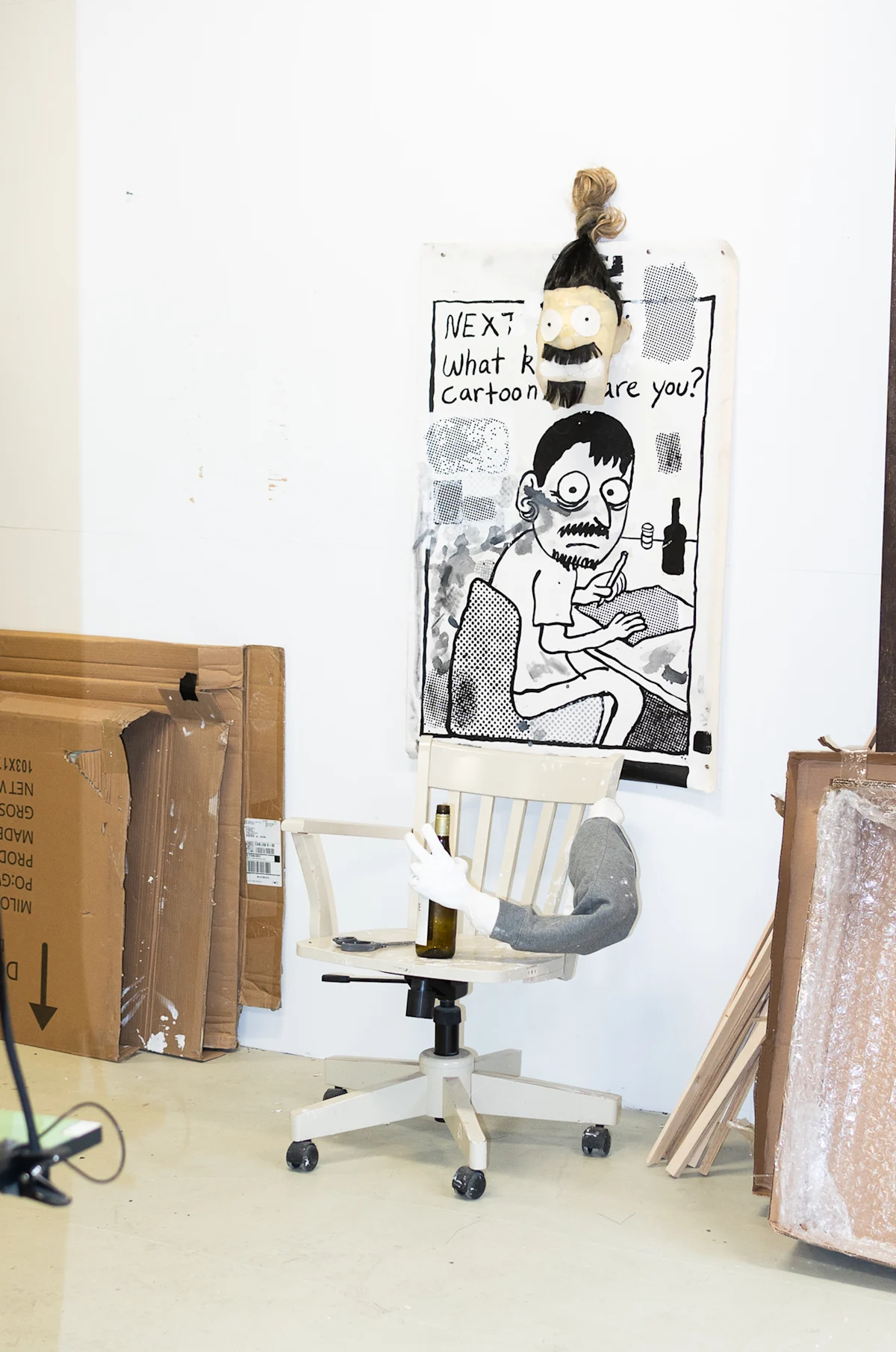
This is a good point to talk about the artwork from Hunt Gallery: they’re black and white, relatively similar in size, and they harken back to your comic work, but play with the expectations of visual storytelling. Do you think of them as a reduction to the core principles needed to convey meaning or mystery?
⎯⎯⎯ I think the show at Hunt Gallery in February was a really good first step. I was in a residency in Portugal a couple of months ago, and I leaned more into the playfulness of language. I’m thinking more about language than image these days. What emerged in Lisbon were these double entendres—plays on words where a sentence could be read back to front or in two different ways to mean two different things.
I was thinking about sentences that refer to being, but also about making. One piece I made was a hole with a word bubble coming out that said “telling cracks in the style of poetics.” Either it’s about the cracks being telling—that the style is cracking and it’s telling because you see the cracks—or someone is telling about the cracks in a style of poetics. It could be action or description. They both point to living or making.
I’m thinking about how to keep creating these little word puzzles, these weird riddles for the canvas. Lately I’ve been paring down the iconography—the words come out of a hole or the smoke of a cigarette, but not much else. As long as I have that as the container for these poetic experiments, the visuals might again become more diverse. I’m on a ship going between language and image, tottering between the two at all times.
Yeah, and they’re both evolving together. Are you a fan of René Magritte?
⎯⎯⎯ Not in any explicit way, but I think about Ad Reinhardt a lot.
OK, yeah, that makes sense.
⎯⎯⎯ He was very language-oriented. He’d go from making completely black canvases to these pretty hammy comics about the slippage of language and about looking. He’s a definite point of reference.
That’s when you start addressing these primary aspects of art making: blankness versus mark making; void versus being. I feel like you're dealing with that area where language and art collide. You reach a point where art making becomes explicitly about being, as you're talking about. It’s an interesting journey you’re on right now. It feels fresh and old at the same time.
⎯⎯⎯ Yeah, I appreciate that. It’s also a great challenge to convey something without the comfort of having 200 pages to do it. In comics, you can keep explaining and explaining. On a canvas, you have one moment where someone looks at it and it’s fixed there.
Visually and technically, I like to implicate the viewer. So much of the comics are about the fictions we tell about the world we live in—what curators are like, what artists do—how we’re all building this together. I try to translate that into how someone encounters the painting and how the viewer is implicated in its design. I have one piece where the letters are backwards, as though you are the subject and whatever’s in the painting is the viewer. It says “the feel of being seen.”
The subject of the painting is looking at their phone—they’ve been seen, their message has been seen, but you haven’t responded. You’re in the phone looking out at the subject of the painting, but you’re also the subject of its gaze back at you. In that sense, the gallery becomes part of the punchline or the visual gag. I’m thinking through how I can activate the paintings so that you feel physically part of the concept.
Art making is typically thought of as a private experience that then gets released into the public. But the way you’re speaking about it, it seems like you’re already implicating the public—or a viewer—while making the work. Are you intentionally subverting that narrative of privacy?
⎯⎯⎯ I value direct communication and accessible aesthetics, so it has less to do with public versus private and more to do with meaning that’s communicated and hidden. I experience a lot of contemporary art where the meaning is hidden by the abstraction of the arrangement, or there’s a virtue in it not being immediately understood. I’m trying to figure out if there’s a way to create something profound where the meaning is directly communicated without being pedantic. This is why I sometimes struggle to make things that are so direct—conceptually non-direct.
I want to ask about personal mythology. You have a backlog of comics and characters you’ve created. Do you feel that contributes to your own personal mythology? And if so, do you draw from that to make the more direct, language-based art you’re making now?
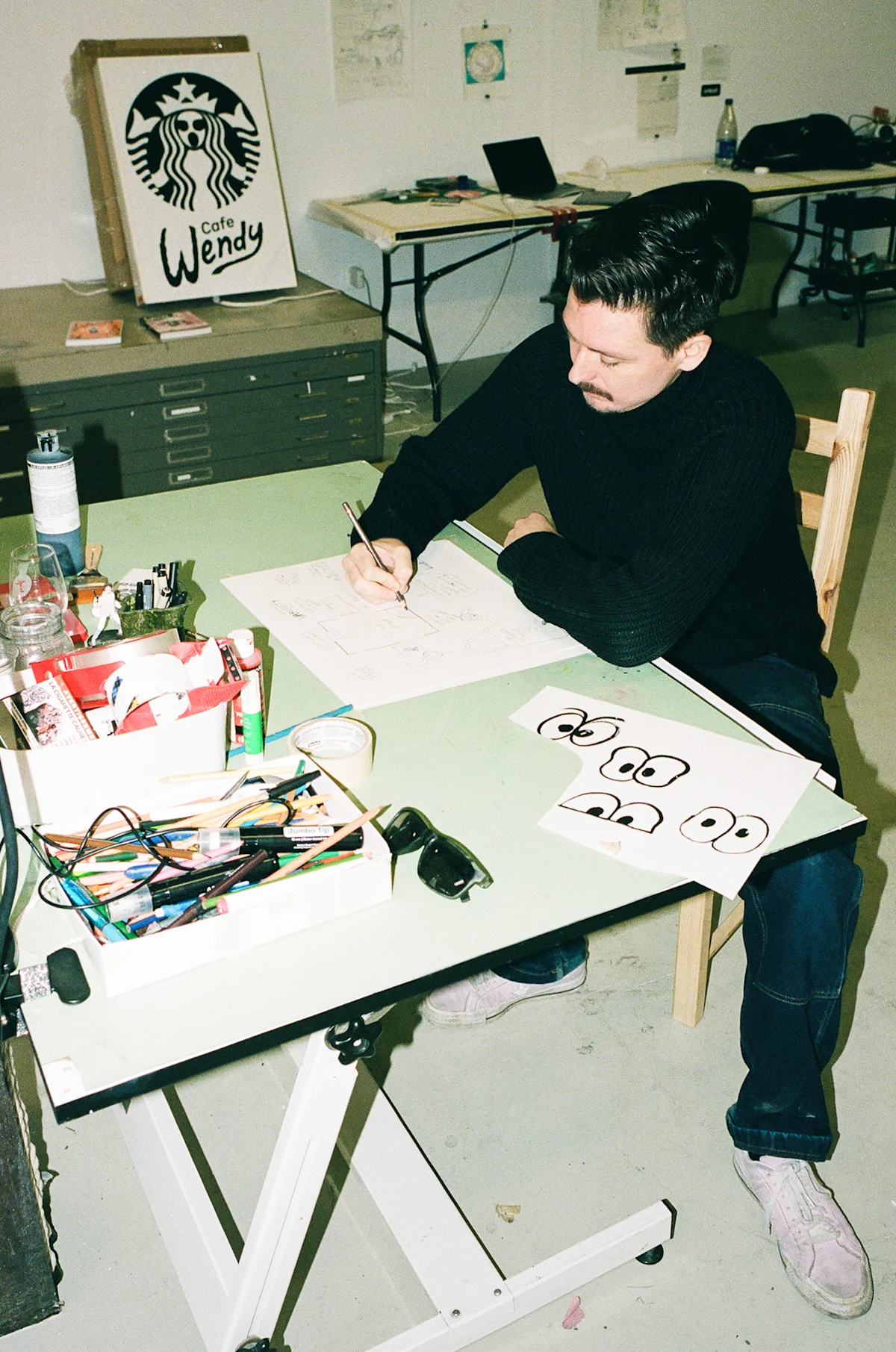
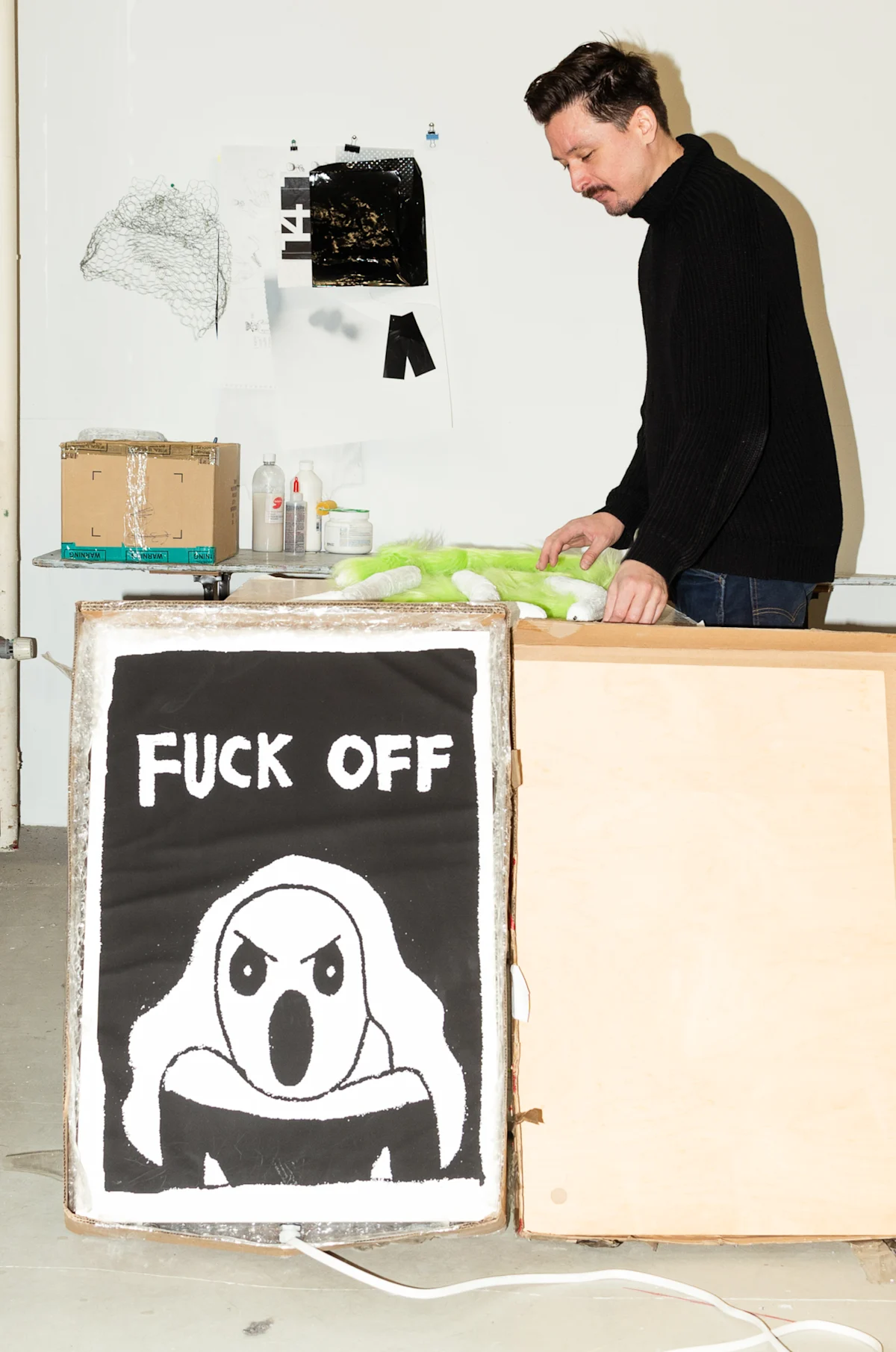
⎯⎯⎯ I’d say it was a way to diffract the different ways I think about things—or the different subjectivities I have—into different characters: Screamo, the gay hedonist; Wendy, the desperate artist; Winona, the Indigenous performance artist. Each can have disagreements and conversations with each other or butt up against each other. It’s a way for me to consolidate and think through how I might approach an issue or something happening in my life or the world.
It sounds schizophrenic, but it’s an interesting way for me to come to terms with how I feel, because the different parts of me become different characters who can talk to each other.
It reminds me of family systems therapy—
⎯⎯⎯ Yeah, I’ve been asked in therapy to see parts of myself as different ages. I’ve always found it difficult—half because it’s painful and half because it feels hokey and weird. But on my own terms, it’s great. Coming up with a character that doesn’t have to be you is great, because you can put as much of yourself into them as you want and they still exist as something else. That’s the joy of fiction—you’re never necessarily talking about who someone thinks you’re talking about because it’s fictional. There’s plausible deniability.
I’m interested in what writing means to you. Is writing a prescribed way of storytelling? Is it mark making and signifiers and letters that are inherently empty but we add meaning to? What is writing to you?
⎯⎯⎯ I’ve been fascinated with the texture of certain words together. A string of words can mean ten different things—that’s what I’m exploring. I don’t know if I believe this, but it’s like why some people think French is a beautiful language. You say something in French and it’s beautiful; translate it directly into English and it doesn’t hit the same way. I’m exploring the texture of what a few words can do together—how they can ring in your head for days, how they can create clarity and ambiguity at the same time. An image can do the same.
So does the image come along with the textures of words, or do they arrive at the same time?
⎯⎯⎯ A good example is something I recently stumbled on. I have an upcoming presentation I’m working on and I made a canvas as part of a larger text-based piece. It just says “me.” It looks insane in my studio—like the most self-obsessed artwork ever. The edges of the block letters are shaded with this halftone dot style, which has been a big aspect of my recent paintings. But I forgot to shade one corner. I texted my friends asking if anything looked off, and everyone said no, but I thought it was poetic to have some part of me missing—literally part of “me” missing. It’s a visual metaphor, a gag, but it doesn’t change the painting unless you look really hard. So I kept it. That’s how I came up with the title: A Part of Me Is Missing. It’s low-hanging fruit as a gag, but the walk to get there was satisfying.
Is this piece you’re referring to a part of a larger body of double entendres? Do you work in series, clusters of images or gags? Do you keep a notebook? How do you create the next set of images, and how do you prepare them for display?
⎯⎯⎯ Paintings are a good format for a series. I’ve done two and then a third series of drawings. But I don’t have immediate plans for that because I’m preparing for a solo exhibition at the Darling Foundry in March. It’s completely different from the paintings. I’m presenting a science fiction puppet film I made this year—very DIY miniatures, very 90s Liquid Television, MTV aesthetic.
I’m presenting it alongside new installation and sculptural elements, and some more textural video that includes text similar to my paintings—abstract, poetic language, but in a science fiction aesthetic. It’s so left-field from the paintings that I’m curious what threads will connect the two modes. I haven’t fully worked that out yet. But I know I’m making this little furry guy in a hoodie sitting in a chair. I’m populating it with characters. His hoodie will say “dopamine hitter,” and I’m thinking about how dysregulated everyone I know is, and how that relates to aesthetics—how we find regulation or dysregulation through what we see. It’s very nebulous right now.
That also sounds immersive—and not at all like the pared-down, minimalist black-and-white paintings you made recently.
⎯⎯⎯ Yeah, it’s freaking me out a little. It makes me wonder if I need to pick a lane. It’ll be interesting to see whether this exhibition becomes a compromise between the minimalism of the paintings and the maximalism of my other practice—some meeting place in the middle. I don’t know yet. The experience of putting it together is me figuring it out. It’s nice to have an experimental space. I think it’s important not to know exactly how something will turn out. If I got locked into the language of my paintings and knew the exact alchemy and punchline percentage, it would grow stale. I don’t know how much longer I’ll be doing that exact thing with canvases. It might become something new. I hope so.
To tie it back to the start, do you still have people giving you honest feedback that propels you forward—especially for the more maximalist work?
⎯⎯⎯ The short film doesn’t have the same audience as my other stuff. It’s an outlier that’s still fermenting. It doesn’t seem to have the same power behind it in terms of eyes. It’s the black sheep right now. But it’s found an audience at film festivals—especially queer film festivals. Bizarrely, the science fiction festivals don’t resonate with it.
I’m always interested in throwing something out there and letting it cook. Wendy at first—many people thought it was stupid. But I didn’t give up on it. I decided it was OK if people didn’t like it. Eventually it grew into something a lot of people resonate with.
Yeah. Does that tepid initial response affect you? Or do you feel like it means it’s growing?
⎯⎯⎯ Not everything is a success. I’ve had a couple fantastically obvious failures that, in retrospect, had very little redeeming about them. But that’s valuable—that’s part of life. If you can survive that, then great; otherwise, you’re just making art to succeed, and I don’t know if that’s a good reason to do anything.
– East Room is a shared workspace company providing design-forward office solutions, authentic programming and a diverse community to established companies and enterprising freelancers. We explore art, design, music, and entrepreneurship. Visit our News & Stories page to read more.

