
The latest season of Top Chef Canada culminated in a heated restaurant war between Vancouver’s Alex Kim and Toronto’s Coulson Armstrong. With a final lineup of scallop crudo, pasta, and a maple tart, Armstrong out-cooked Kim by putting himself on the plate. “They wanted us to cook something that perfectly represented who we are and where we’re at in our careers,” he says. “So being able to just cook from the heart and know I gave it everything I had made me proud of every dish.” As the culinary director of Our House Hospitality Co.—Matty Matheson’s restaurant group, which owns Prime Seafood Palace, the swanky steakhouse where he serves as executive chef—Armstrong has already been quietly influencing the city's dining scene. But his latest victory proves that the guy behind the guy is actually the man.
Congratulations on your win!
⎯⎯⎯ Thank you very much. It was an amazing time, and it just touched so many people. Being able to relive it with my family and rewatch it every week was really exciting.
Were you a fan of Top Chef before competing in this season?
⎯⎯⎯ I was a fan of the American version. That's the one I watched seasons one and two. Canadian, I was a younger Cook, and I loved watching and seeing those chefs that are all just, you know, great chefs in Canada now. It definitely inspired me, and the American one, it just, yeah, it was crazy competition, and watching what these chefs would do, it was just very inspiring.
Do you thrive under that kind of pressure?
⎯⎯⎯ People couldn't believe how calm I was. Once the cameras were on and we were cooking, I was laughing and having fun; that was my favourite part. I love challenges, and I think what I do to the day-to-day basis really prepped me. Once I found out that I was going on the show, I was thinking, I gotta train, I gotta do these Black Box challenges. I really tried to do it beforehand, but my day-to-day was just so busy. Keegan, my director of ops at Our House, would buy me a black box, and he would give me a fuckin’ piece of salmon and a vegetable. I was thinking, how is this helping me in any way? It was a funny process.
But what I actually do day in day out was the real training. If I had a really hard day at work, I'd be thinking, I don't need to train. That was my mindset for the month leading up, knowing that I was going on the show. But you don't know what to expect. We would sit there and talk about what the next elimination challenge would be or the quick fire. And not one of us ever got it right.
Tell me about the final challenge.
⎯⎯⎯ Restaurant Wars was definitely more in my wheelhouse: opening a restaurant, creating an experience, and really listening to exactly what the judges wanted. They wanted us to cook something that perfectly represented who we are and where we’re at in our careers. So being able to do North of Nowhere (Armstrong’s winning concept) and just cook from the heart and know I gave it everything I had made me proud of every dish.
Is it right that you found out your wife was pregnant while you were filming?
⎯⎯⎯ Yeah, that is correct. We didn't have our phones for three days sometimes. Then we'd finish filming at 11 o'clock at night, and then you get handed your phone, and I would turn it on, and literally, 50 messages would pop up. At 7AM my wife called when I was in the car, and she said, “Hey, I'm pregnant.”
That’s really crazy. I can't imagine going through this while being on the show. I'd love to talk about Prime Seafood Palace a little bit. When did Matty approach you? What was the original concept?
⎯⎯⎯ I had just landed in Australia, and I saw through social media that Matty was just in Australia, so I sent him a DM saying, “Hey, I'm looking for work, or just an introduction.” And he messaged me right back and said he was actually gonna be in Australia in two weeks and asked if I wanted to grab lunch. When we met up, he was like, “Hey, I'm building this thing in Toronto called Prime Seafood Palace. Do you want to be the chef?” We hung out for 24 hours straight and ate like, four meals in a row. I slept on it, woke up was like, “Yes, I want to do this.” He's like, “Alright, it's not actually opening for a year, so keep travelling.”
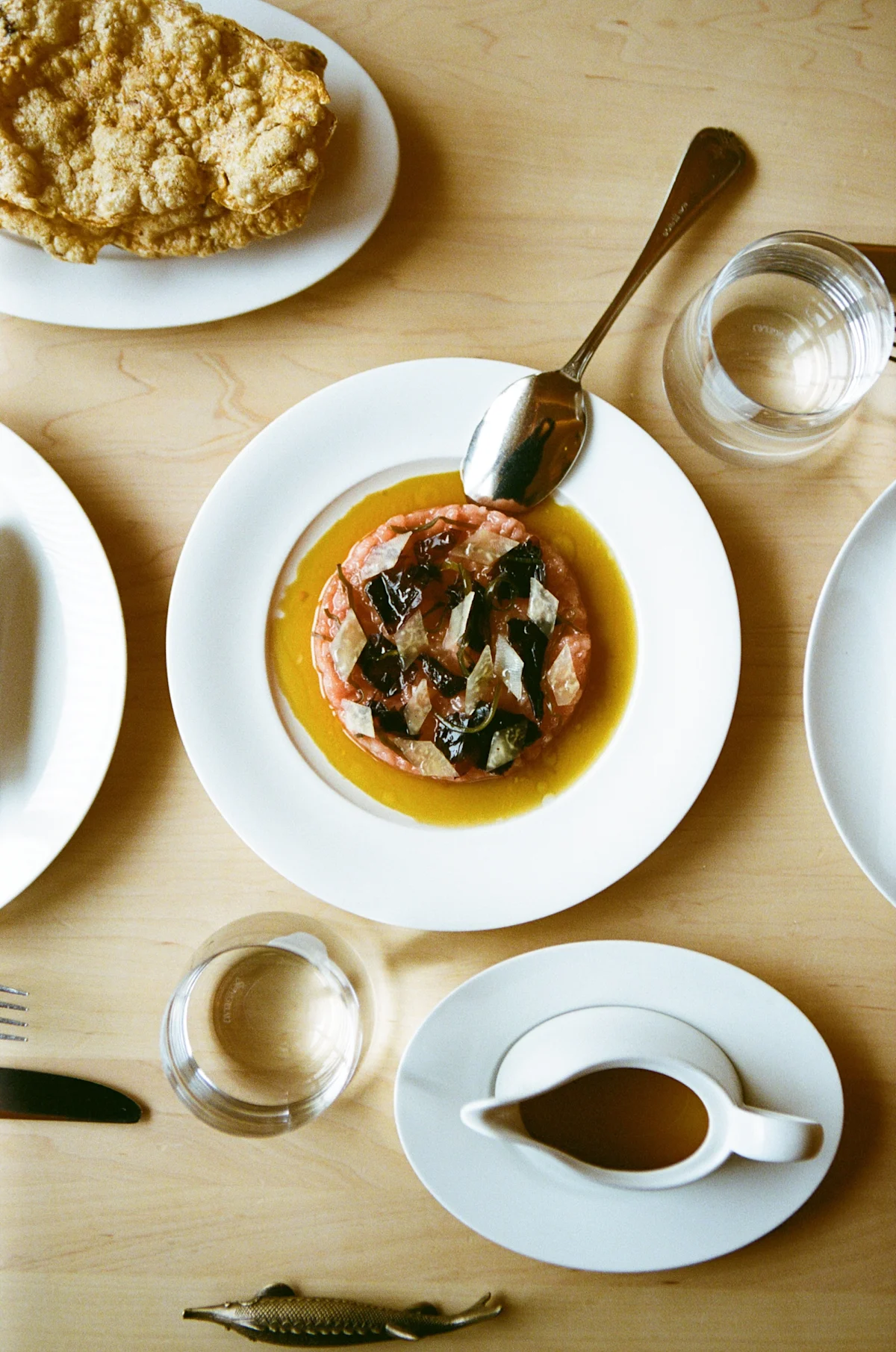
In that year, we talked so much and shared idea after idea. We did flip back and forth from a tasting menu-only restaurant to Omakase to a steakhouse. It was always a steakhouse to start. One day, we had this epiphany when we walked into space after a couple of months, and we decided to utilize our private dining area with a big chef's pass in there to do cold side and pastry, and we wanted to do big steaks and vegetables and seafood. That’s the direction we wanted: minimalist dishes with sauce kind of around the bottom and no fluff. And once we got into the space and started plating stuff, we were like, this is PSP, this is the look. It really set the trend for dining in Toronto, and a lot of places have used PSP as inspiration for what Toronto food is.
Can you expand on that? What kinds of dining trends do you see that you credit PSP with starting? How do you see the restaurant’s influence?
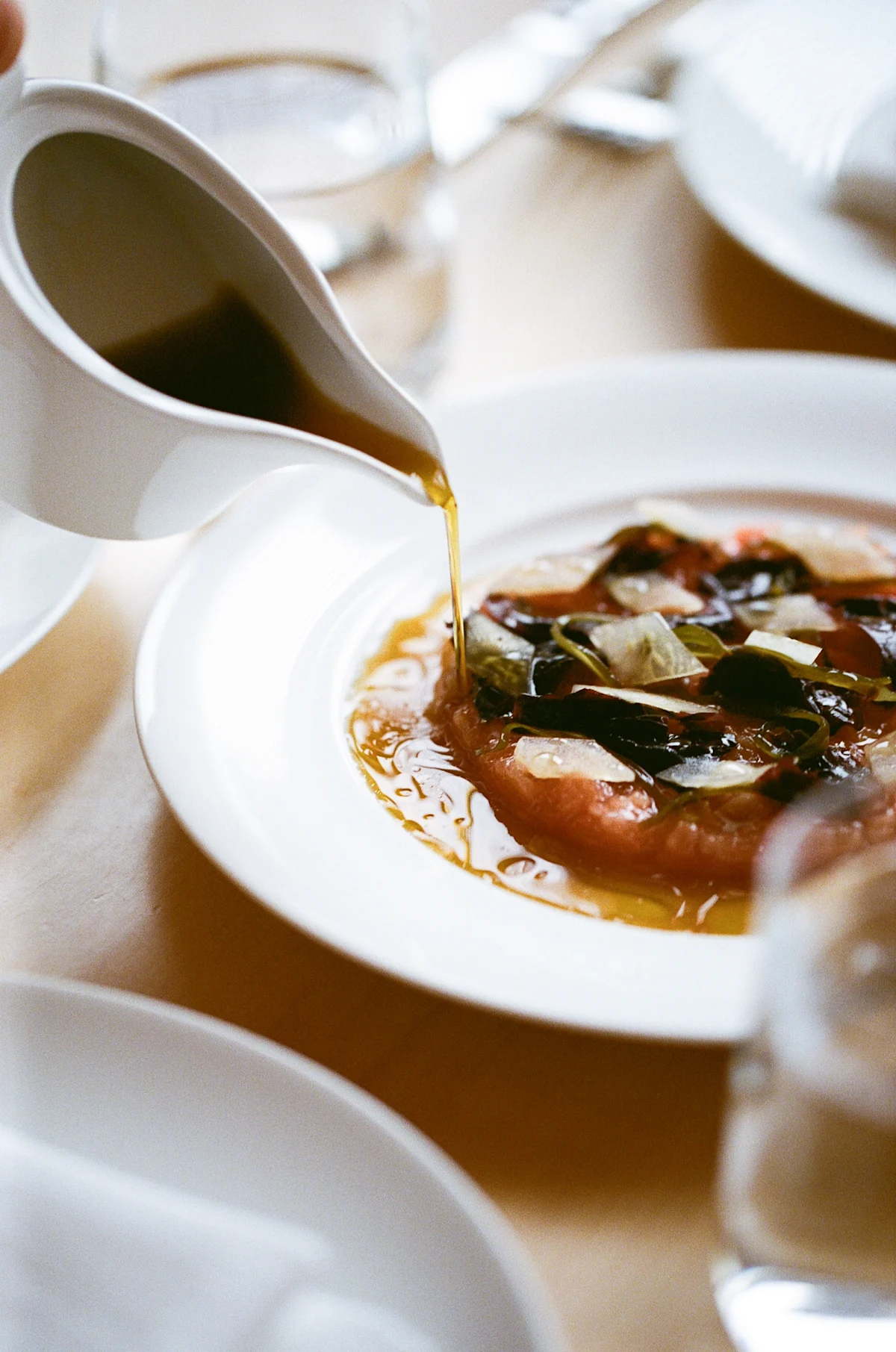
⎯⎯⎯ It goes right to the plate. From where we bought the plates to having a thick white rim—just white, classic, and instant. Also, having these wells where we'd make dressings and sauces and fill the well and put the protein on top that. That really sparked Prime, and we see that influence across Toronto.
You’re the culinary director of Our House, overseeing a range of really different restaurants. What does that job entail?
⎯⎯⎯ Each concept is different from the ground up, from what the room feels like to the menu. So something like Rizzo’s where it’s chicken parm and side spaghetti and mozzarella sticks, we created this concept, and then the work and the creativity that goes into that restaurant…everything's been very thought through. And we're very particular on how we style things, because we want people to feel a different experience, and different cuisines give you different emotions. With every concept, you need a different palette and a different approach. And if you have a different set of skills that comes with that, I find. Prime Seafood Palace chefs are just more highly trained and skilled, but then taking a local at Rizzo’s and giving them this level of training that makes them on the same level as somebody at Prime, just in a different way.
Between fine dining and the more accessible spots, do you have a preference for one environment over the other?
⎯⎯⎯ At a place like Rizzo’s or Matty’s Patty’s, people have a lot more to say and aren't afraid to give criticism, because anybody can cook a cheeseburger or red sauce at home, so there's a familiarity there. People know what things cost, and nobody is trying to get ripped off at that price point, whereas, a place like PSP, people are more praise-worthy and understand all the craft and artistry that goes into it.
It seems to me that more chefs are thinking like fashion designers in terms of who they want to cook for. Just as designers that serve a small luxury clientele want to work with Uniqlo and dress the masses, some chefs want to work on more than one level: to cook at a really high level and for a lot more people, or to cook different kinds of food.
⎯⎯⎯ Yeah, I totally agree, and I can see the comparison. I actually watched this video last night with Aaron Levin, the fashion guy, and he was just saying, the thing about fashion is that you can't criticize anyone for what they choose to wear because it's so personal. And I think that people do the same with food and being a chef of multiple venues.
How have you seen restaurant culture evolve?
⎯⎯⎯ Since my start 20+ years ago, it's definitely changed so much. It's a big balance of allowing people to heal and identify issues that are in the space, and then having a place where we can all talk about them and solve these issues together, and knowing that, like, “Hey, this is the Prime Seafood way. It's not my way. It's not Matty's way.” It's bigger than all of us, and it's a whole team in here, collectively pushing to be better and to run a business and understand the needs of that from a financial side, to a guest experience.
How does the Toronto restaurant scene compare to other cities? What’s the precepting vs reality?
⎯⎯⎯ I think we've come a long way in the last 10 years, but I think in Montreal, they’re doing better cooking and having better experiences. Sometimes Torontonians like to look at the shiny new thing, and I think we're guilty of that, too. We've opened five restaurants in the last five years. We're always thinking about the next, but it's about maintaining what is already here as well, and allowing those places to really shine.
Which restaurants are doing it right?
⎯⎯⎯ Marco (Frappier) from Mon Lapin and La Lune (in Montreal). They're just cooking some really clean, good, thoughtful food using the right service points and wine. It's yummy bites that you just want to eat. So I think, I think like Zach (Kolomeir) from Dreyfus and Bernhardt's have kind of taken that Montreal feel and style of cooking, and made it his own.
What do you cook at home?
⎯⎯⎯ This time of year, a lot of one-pot wonders, like white bean sausage kale soup. Or simple cast iron cooking; some sort of protein with a sauce and a vegetable.
What do you want to be cooking more of at PSP?
⎯⎯⎯ More vegetables, more seafood, more specialty ingredients.
–East Room is a shared workspace company providing design-forward office solutions, authentic programming and a diverse community to established companies and enterprising freelancers. We explore art, design, music, and entrepreneurship. Visit our News & Stories page to read more.

