
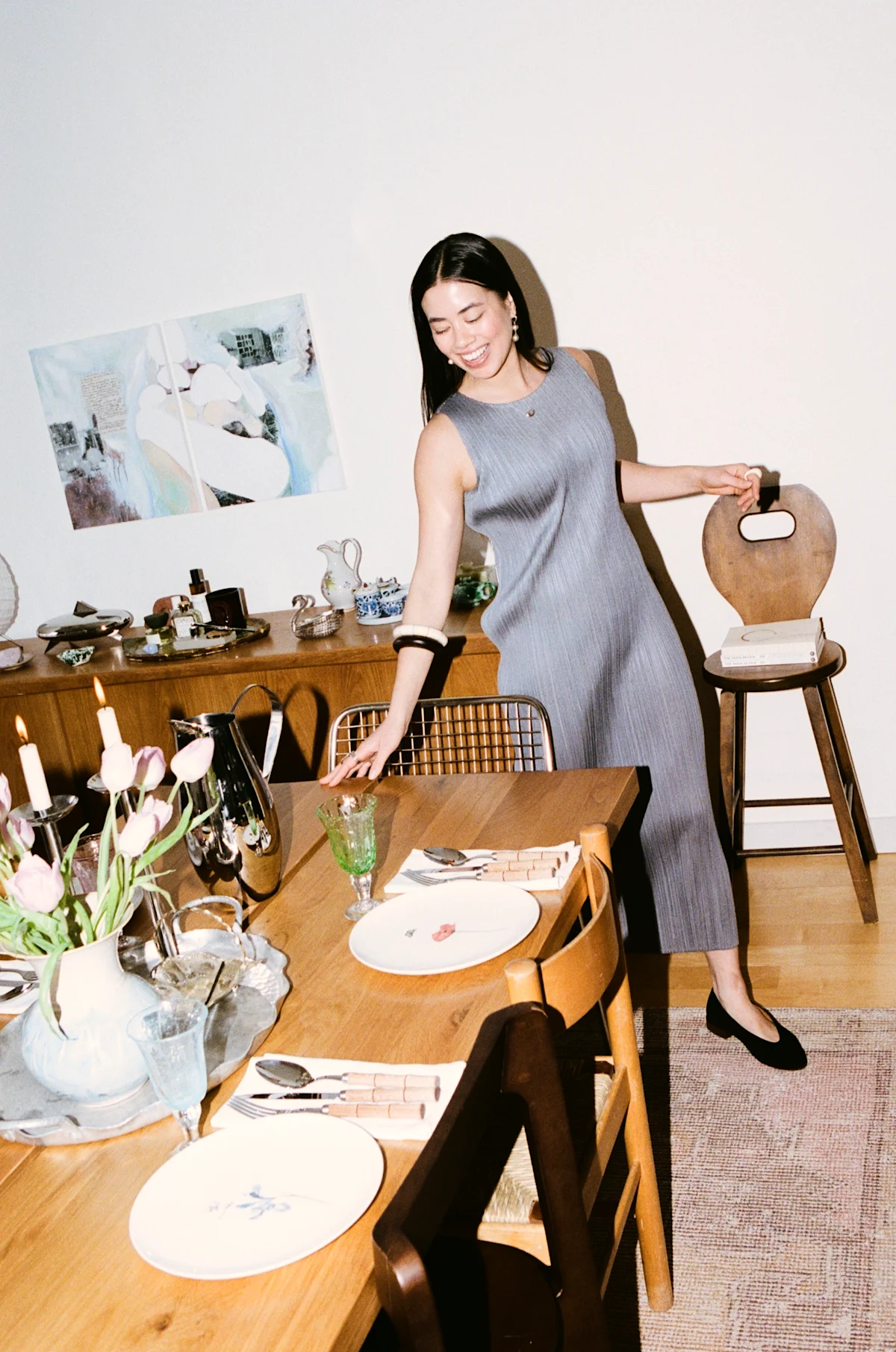
Sasha Mei has never been content with staying in one lane. What started as an Instagram presence in the early days of social media has evolved into something far harder to categorize, a practice built around the pursuit of taste, connection, and the quietly radical act of gathering people around a table. Through Yu + Mei, the creative community project she co-founded three years ago, the Malaysian-Canadian creative has turned dinners into a medium, tablescapes into a craft, and conversation into the main event.
The work that you do is very multifaceted and broad. It reaches a lot of different fields, areas, techniques, and professions. In your own words, how would you identify yourself and your profession?
⎯⎯⎯ I’ve always made my work about the pursuit of taste. Whatever that entails, I think I’ve made it my job to publicize and share the search for that, in whatever form or facet it may take. I did start off as an influencer, as one does, way back in the early days of Instagram. It was a nice segue from Tumblr, which I started as a teenager and became somewhat popular on, before switching over to Instagram, as many people did. At the time, if you had an idea, you could run with it, and people would follow. Now it’s a completely different landscape, but I feel lucky to have gotten in when I did because it allowed me to nurture connections, build relationships, and meet people. It felt easier back then, and there was a real energy and excitement around the new creative space. From there, I segued into Yu + Mei, a creative community project I started with my co-founder, Amy, about three years ago. That came from a place of burnout and creative stagnation. I didn’t really know what I was doing anymore, and I knew I couldn’t just keep taking outfit photos for the rest of my life. I wanted to do what I really loved, which was bringing people together and eating really good food. The concept of Yu + Mei stemmed from that, as well as from my experience in college of not really fitting in. I found that dinner environments—bringing people together over food—made me feel comfortable in my own skin. As an influencer, you go to a lot of events, and the usual question is, “What are you working on?” I wanted conversations to extend beyond that, because the few times they did, I left events feeling fulfilled and reminded of why I started in the first place. I think I had to have my first career as an Instagrammer to start this project, because otherwise, I wouldn’t have known anyone. It’s been a really wonderful transition into doing this more seriously. We host parties and bring together good people, not necessarily just those in the creative industry. We want people who bring good conversation and good energy into a room. It started as Wine Nights and has grown into a series where we collaborate with friends who are incredible chefs, florists, and designers. We create a whole world that people get to enjoy.
I appreciated that you started with taste. Taste is about things we like and gather around ourselves, but it’s also the sensation of taste.
⎯⎯⎯ Yeah, it’s food. It’s eating food. It’s the whole sensorial aspect of using things. It can extend into beauty and into many different industries.
I love talking about taste because it’s this gossamer, ephemeral thing that’s hard to pin down. I once spoke with an art director who said that what defines an art director is having good taste. I remember thinking, what does that really mean? What is taste to you? How does taste define a person? Is it objective, with some external validation, or is it simply what someone likes?
⎯⎯⎯ That’s a great question. I’m glad you brought up external validation, because in this world, it often feels like taste is defined that way. That’s when we start seeing everyone funnelled into one style or one version of taste. But for me, it’s more of a lifestyle thing.
When I talk about the pursuit of taste, it doesn’t just mean my taste. Taste is a condition or feeling I get when something feels right. I know when something resonates with me—when there’s a positive reaction, attraction, or magnetism toward an idea.
Pursuing taste isn’t just about my own preferences. It’s also about understanding other people’s tastes, seeing how they resonate with me, or why they don’t. That’s how I think about it.
Can you elaborate on appreciating other people’s tastes? Is it about finding beauty in something even if it isn’t your own preference? Especially when you’re bringing people together who don’t all need to be the same?
⎯⎯⎯ Experiencing other people’s tastes is about seeing how they experience that same sense of alignment or comfort that I feel with my own. You can tell when someone feels comfortable in their own skin. They’ve surrounded themselves with design, nourishment, aesthetics, and sensorial elements that please them. That’s their sense of taste, and I love immersing myself in that.
It happens through experiences and interactions. When people enter the Yu + Mei world, that reflects our sense of taste. We don’t necessarily care whether everyone likes it or not, which I think is actually a sign of taste.
Other than the client, of course.
⎯⎯⎯ Right. They’re there to experience our interpretation of what they’re trying to express. We create a sense of taste and a whole world for them. People come to us knowing that what we do aligns with what they want.
We’re selective, and that’s partly why it isn’t my full-time job. The upside of that is we can be picky and work with people who align with our taste. That synergy makes creating a whole world much more seamless. Creative conflict happens when tastes clash, and that’s something everyone in the creative field experiences.
When you encounter resistance or challenges around creative direction, how do you navigate them? What tools do you rely on?
⎯⎯⎯ Distance is important. Space from a creative project helps. I work mostly in events, and with events, you don’t know how things will turn out until the day of. It can feel like a gamble.
What helps is stepping away—literally going for a walk. I also try not to take myself too seriously. I’m making dinner for people. I’m creating a nice space. We’re not saving lives, and I didn’t invent dinners. Remembering that helps.
That perspective makes creative conflict easier to navigate. I trust myself and know things will work out. Sometimes you just need to step back and remember that someone across the world doesn’t care what you’re doing.
Can you reflect on the everyday aspect of dinners—gathering, eating, and the flattening of social hierarchy?
⎯⎯⎯ I am from Malaysia, though I moved to Canada when I was four. I don’t have many memories from there, but visiting relatives later came with language and cultural barriers. What always brought comfort was mealtime. No matter the family drama or the day people had, everyone sat around a table and ate together. It was grounding. My grandparents separated late in life, but even then, we still had dinner together. We’re all there to eat and share something primal. Differences get set aside, even if only temporarily. Food brings people together, and there’s something magical about that. Especially now, when the world feels so polarized, food and the table can still ground us.
Are you familiar with the artist Rirkrit Tiravanija?
⎯⎯⎯ No, I’m not.
He creates situations rather than objects and is known for cooking and serving food in gallery spaces.
⎯⎯⎯ That’s funny. I love that it turns food into an art form while also placing it in an exclusive context. It challenges ideas of accessibility and value.
People walk away having consumed the thing they came for.
⎯⎯⎯ Exactly.
So with your events, you’re essentially setting tables.
⎯⎯⎯ I’m a professional table setter. That’s my job description now. I might even update LinkedIn.
Would you ever open this up publicly, or expand it beyond private events?
⎯⎯⎯ We’ve kept things private because of funding and guest list control. That curation is important. Where we’ve opened up is by focusing more on the table itself rather than every aspect of the event. Brands can commission tablescapes while handling guest lists themselves. It’s been interesting to let go of some control.
That’s exciting.
⎯⎯⎯ And scary.
That’s a good sign.
⎯⎯⎯ It is.
Let’s talk about curation. How do you limit scope when building tablescapes?
⎯⎯⎯ I try not to look online for inspiration. I prefer starting with colours or objects from other mediums. A group of paint colours I saw in Paris once inspired an entire dinner. Another time, it was ceramic glaze swatches.
We usually start with a colour palette or a single object and build from there. Narrowing the focus helps avoid overwhelm. Everything—graphics, music, food—connects back to that core idea.
Does the food derive from that as well?
⎯⎯⎯ Absolutely. Everything connects. The food reflects the season and the atmosphere of the table. We don’t cook ourselves, but we’re good at finding chefs who complement the world we’ve created.
How do you find collaborators?
⎯⎯⎯ By going to events, talking to caterers, and following recommendations. We always try the food first. Pop-ups are great for discovering new talent.
What are some unlikely places you’ve found inspiration or collaborators?
⎯⎯⎯ Running into people on the street. Spontaneous interactions are my favourite. That organic recognition of shared taste feels like we’re doing our job.
What are you looking forward to in the coming months?
⎯⎯⎯ Travel. New environments are endlessly inspiring. I’m also excited about smaller, more intimate gatherings—hosting people at home and trying new things.
As your circle grows, have any collaborators become more permanent?
⎯⎯⎯ We have recurring guests who bring great energy and conversation. They help set the tone and make events feel relaxed.
What makes for a good conversation?
⎯⎯⎯ Asking good questions and listening.
– East Room is a shared workspace company providing design-forward office solutions, authentic programming and a diverse community to established companies and enterprising freelancers. We explore art, design, music, and entrepreneurship. Visit our News & Stories page to read more.
