
There is no logical reason to launch a fashion brand today. It has to be a calling, not just a career — especially when it’s your name on the tag. Such is the case with the designer Wanze Song. With her brand Wanze, Song seems to be hitting her stride both creatively and commercially. Her signatures include artisanal techniques, utilitarian details, and wearable tailoring in Japanese fabrics. And she’s honed her design language season over season, winning over buyers from discerning retailers across Canada, the US, and Japan. Ten collections later, Song proves she has the talent and tenacity to make her brand a real business. And that sometimes, the cream really does rise to the top.
You brought your collection to Paris again last winter. How did it go?
⎯⎯⎯ We picked up so many more stockists in Paris, and it was the first season where I felt like, if I can keep this trajectory, I can actually reach the goal of what I want the brand to be. For the first time, it felt really hopeful. Buyers had circled for seasons, always saying they wanted to revisit; this was the fourth time some came, and they finally committed. It felt like everything was falling into place, and like all the hard work was being seen and validated. My next collection will be the 10th, wrapping up five years. I want to do something celebratory for it. The hard, foundational part has passed, and only now is the brand sprouting onto the surface, with people discovering it for the first time.
You mentioned once that you have a bunch of repeat buyers who order something every season. How much does direct-to-consumer support your business?
⎯⎯⎯ It really does. When I get good direct-to-consumer orders, three of them can equal one smaller retail store, and it's cool to see people coming back season after season. Obviously, the product is doing the work. But it's nice to see it working because for me, there are so many unknowns. I can't lean on direct-to-consumer to grow the business, which is why I want to do more in-season pop-ups in different cities, where things are ready to buy. Either way, I feel so lucky that people show up, that they're present and sharing their time with you.
When did you launch Wanze? Why start your own brand?
⎯⎯⎯ I launched the first collection in March 2022. I'd moved back during the pandemic and was working for a small local brand, and I had a lot of free time, so I started making things, and that led to friends and family wanting pieces. It started with a pair of trousers, and from there came menswear and the dumpling bag. I also got a bit of funding — about $10,000, which I spent in two weeks — to set up a studio and create that first collection. I went into it not expecting any outcome, but more out of a need to exercise my own understanding and perspective on garment making. I'd already worked in the industry for eight years straight, and the pandemic finally gave me time to think about my own outlook. It was an exercise to see if I could create something people would interact with and want to wear. That was something I'd questioned a lot while working for other brands.
Where did the idea for the dumpling bag come from?
⎯⎯⎯ It was the end of 2019. I'd come back from Shanghai, and I was so bored, staying with my parents in Scarborough. I brought up my old sewing machine from high school, and it felt really nostalgic. Part of me finally understood why I'd worked so much all those years — I was just craving to make things. At the time, my mom was making a lot of dumplings, and she'd make me sit and fold them with her for hours. I wanted to bring that idea into a bag, something familiar and connected [to me] that felt comforting and easy to wear. I posted one photo on Instagram, and that was it. Then a friend, her mom, and her aunt all wanted one, and suddenly it went from selling three to 20 to 100 to 400 — all of it me cutting and sewing every piece by hand. After the pandemic, I went out for the first time in two years, and people kept asking, "Are you the bag lady?" I went home thinking, I'm not the bag lady — I don't make bags, I make clothes. That's when I started building a real collection.
Were you building all of that on your own?
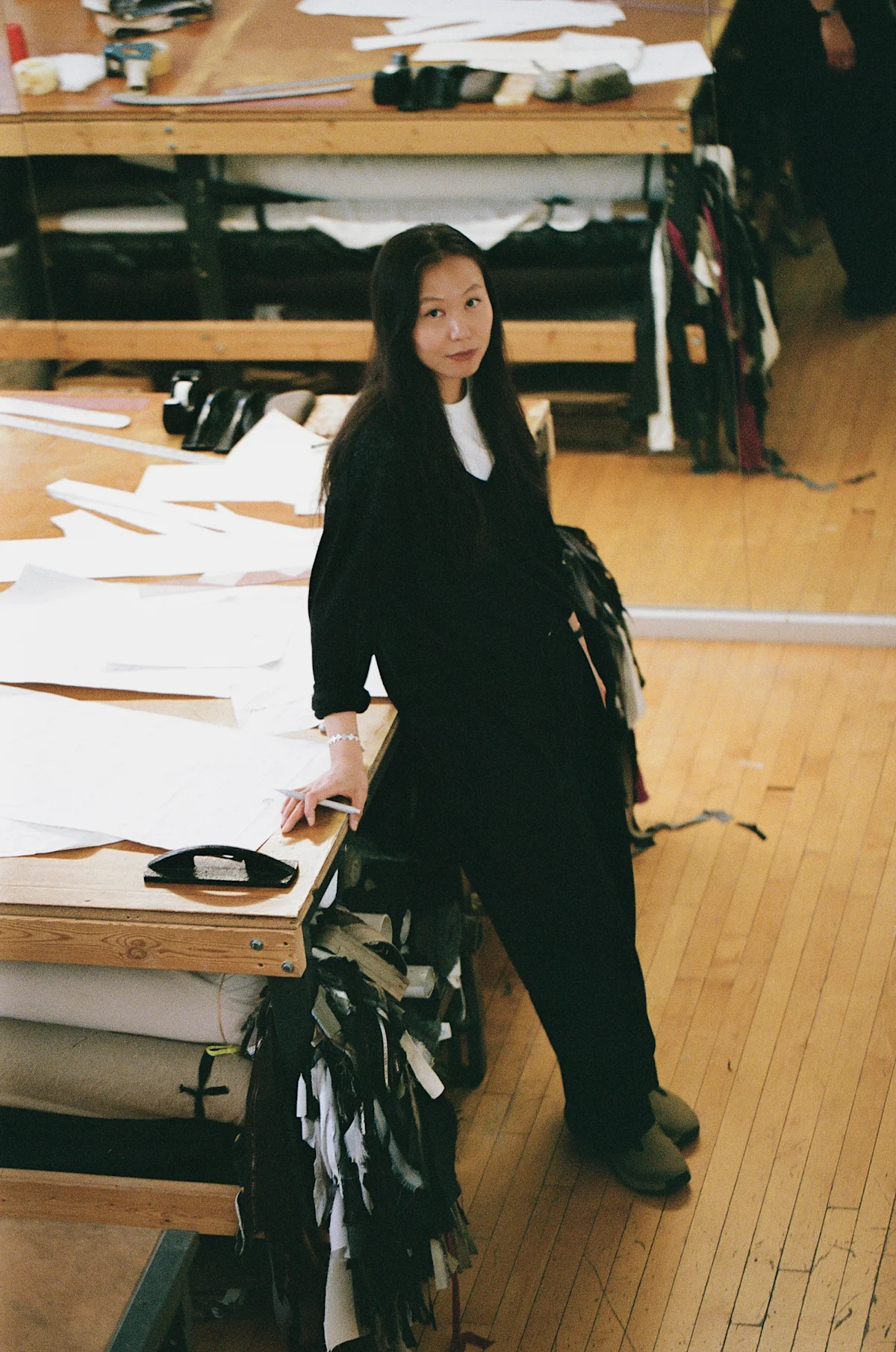
⎯⎯⎯ Completely. When I started, I knew it could be a failure, but if you're going to go for it, you have to put in 200% and take it seriously. Even if there's no structure, no resources, nothing in the city. You have to build that yourself. For the first collection, I was still working three days a week at another brand, then dedicating the rest to the studio, 9AM to 10PM every night, getting a 40-hour week into four days. I did that until I could go full-time in 2023. In the beginning, it felt like I was doing all this work and it was unseen by anyone, but I knew it mattered to build a foundation, so I just cracked away.
You once interned at Kiko Kostadinov in London and worked for a designer in Shanghai. Your friends from fashion school are designing for Houses in Europe and Asia for big houses. How did you feel moving back to Toronto?
⎯⎯⎯ I was definitely clouded by the facade of the industry. Because I was travelling so much and working for established international brands, I felt like I was beyond this place, and the pandemic forced me to surrender. Living in Scarborough, in the middle of nowhere instead of Shanghai, where everything was happening, I started questioning why I needed to be in those spaces. I realized it was all through osmosis and persona: I was "cool" because I was associated with certain brands and names. But as I shed those layers, I thought, actually, you are nothing, because you haven't shown anything of your own ideas. There's nothing tangible out of you personally, so you should ignore all of that, look inwards, and prove yourself. I was so insecure: am I as talented as I think, or is it just a facade I built in my own head? I faced that over and over until I thought, you know what — fuck it, let's just try it. That's the only way to know: are you there, or are you not? That's the deepest fear and challenge of being a creative person — you're comparing yourself constantly. Staying with my family helped me really look at myself, and I decided I'm just going to make things here.
Do you think it still matters where a designer is based?
⎯⎯⎯ I think you can make it anywhere these days if you really want to create something. People use all these excuses, but at the end of the day, with the internet and how connected we are, if someone is making something cool and it's being shown and shared, people can see it no matter where you live. So it no longer matters where you're making things.
How has the internet played a role in building your brand?
⎯⎯⎯ Honestly, it's mostly people discovering the work on Instagram. It's a great starting point — everyone has a blank canvas, and if something's interesting, we all see it collectively, wherever we are. So you can build a global business while staying in your own city, in your own bubble, making things. It's harder in Toronto, because there aren't the structures or resources you'd find in New York or London, where everyone works seven days a week, ten hours a day. I wanted to take what was valuable from that and leave what I didn't believe in. I want the separation of my personal life and my work life — I think that's the ultimate key to long-term success and well-being. We work hard, ten to six, but when I cut off at six, I think about dinner, a friend, Pilates, my book, and a movie. In that fashion bubble, I felt suffocated; everything we talked about was fashion. Coming back here was so refreshing. Having dinner, talking about politics, finance, music, and movies. I'd been lacking that side of me and didn't really know myself outside of work.
How does being a fuller person make you a better designer?
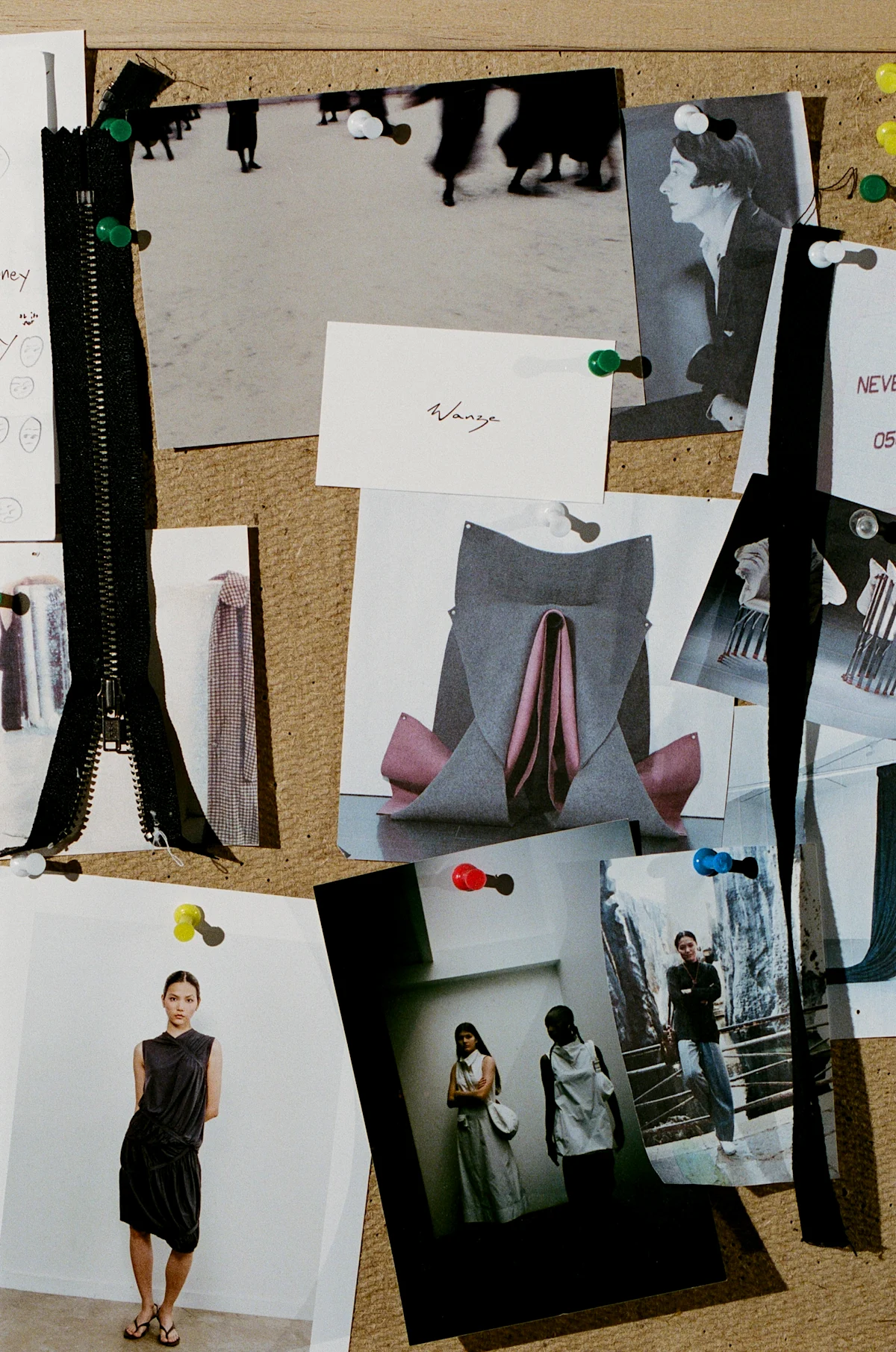
⎯⎯⎯ When you're a full person, you understand not just how to make clothes but how the world operates, and that helps you understand people's needs, desires, and psyches. It all comes back to the real questions: why are you creating, who are you creating for, and why does it exist? Those are the questions you need to answer to have your own thesis. My ideas come from everyday life, like a character in a film, or a construction worker in Japan with all his tools, looking so proper and full of dignity. It's those little things I catch day to day that inspire me. You have to be out in the world, immersed in your surroundings, for those things to come back into your own ideas.
Do you pay attention to capital-F fashion?
⎯⎯⎯ I still look at everything every season, from smaller labels to runway, just to understand the market — what's missing, what's been done well. You can appreciate it when someone pushes the boundaries of making, even if it's out of reach. But I never saw myself as a fashion designer, I always thought of myself as a dressmaker, a garment-maker. Even at other brands, my job was pattern-making: the shape, the silhouette, how a garment feels on the body. So I come from a product standpoint, like, can this stand on its own against everything else in a store, and make someone pick it over the others? The best designers in that more wearable world are all thinking about everyday pieces that connect to reality. I used to think Margaret Howell was boring; I didn't understand what it meant to make something valuable, because it felt too simple. But it needs to fit into people’s day-to-day. To do that well is actually the hardest thing.
How do you want people to feel in your clothes?
⎯⎯⎯ That's my favourite part, and I always get emotional. The other night at dinner, someone came up and told me she had a skirt of mine that a friend had given her, and she shared all these stories of wearing it. Those are the moments that tell me I'm on the right track — it's the lives these garments have after they leave me that's the most exciting thing to hear. Someone will say they love the way it moves, that they wore it with a turtleneck and their boots and travelled with it. That's why, in the beginning, I never wanted much marketing — with marketing, you're always pushing a product in front of someone. I just wanted people to have their own experiences with the pieces, to exist with the garment.
– East Room is a shared workspace company providing design-forward office solutions, authentic programming and a diverse community to established companies and enterprising freelancers. We explore art, design, music, and entrepreneurship. Visit our News & Stories page to read more.

